

In recognition of Treaty Day on July 3rd, we sat down with our executive director, Jason Baldes, to talk about the history of the Fort Bridger Treaties and how we all can work to uphold and exercise our treaty rights.
This interview was edited for length and clarity.
WRTBI: To start, what is a treaty and what is Treaty Day, and what does it mean to the people here on the Wind River Indian Reservation?
Jason Baldes: Treaties were promises made with the federal government in exchange for land. And if you look in the dictionary for what a treaty is, it says supreme law of the land.
There have been over 800 treaties made with the federal government, over 400 of them ratified by Congress. But every treaty ever made with a Native American Tribe has been broken or violated in some form or fashion.
Our own treaty, the original one with the Eastern Shoshone Tribe ratified in 1863 was 44 million acres. This was before Wyoming was a state, but would have been about half of Wyoming, northern Colorado, eastern Idaho and northern Utah. Salt Lake City would have been included as well as Steamboat, Colorado and Jackson, Wyoming and a good amount of Yellowstone National Park. With westward expansion, the Oregon Trail and Pony Express all converge through our 44 million acre reservation and created a kind of conflict, which happened in many areas with westward expansion.
Buffalo was declining in number and availability, which was the primary food source for many Native American Tribes. After the Battle of Little Big Horn, when General George Armstrong Custer was killed it really was congressionally encouraged to eliminate Buffalo.
As colonisation is really like picking up, and that’s when our Treaty rights step in.
There is a lot of misconception around treaties. People think that those were grants of land from the federal government to Tribes. And that’s not the fact that’s not the case. It was in fact, and is upheld by federal Indian law.

Photo by Albert Mason Jr.
In exchange for land we had these treaties that guaranteed us certain things, correct?
Treaties were grants of land to the United States from Tribes in exchange for goods and services like healthcare, law enforcement, nutrition, and this is how we have Indian Health Service, Bureau of Indian Affairs, and the commodity programme. Federal programs were essentially established in exchange for land.
But that land has slowly been chipped away?
Gold and steel was being found in the southern end of the Wind River mountains so the Bruno cession happened. Bruno was a federal agent and negotiated, coerced, Tribal leadership to give up that land.
Largely from what I’ve been told is because we were starving to death, people were sick from small pox, and there were a lot of people dying, and we needed to be able to take care of our own and so some of these land deals were done in exchange for money. So during the Bruno session, we lost the southern end of the Wind River, or the Shoshone Reservation.
The McLaughlin agreement around then, was supposed to be one mile by one mile that they were going to take out, but McLaughlin drew zeros and made it 10 miles by 10 miles, so if you look at our reservation map, there’s a big chunk out of the northeast boundary.
The General Allotment Act, also known as the Dawes Act, opened up reservations for homesteading.
This really dismantled the communal land ownership and opened up surplus lands for sale for pennies to westerners that wanted to move on to reservation lands. Fortunately, in 1938, those unoccupied lands north of the river were returned to the Tribes here, but established the Riverton Reclamation Project, which is considered the diminished area of the Wind River Indian Reservation.
Since our original 1868 treaty, our lands have been diminished incrementally over time. And we’re fortunate to have what little we have left.

Photo by Albert Mason Jr.
And Treaty Day is about uplifting that agreement and our traditional way of life.
Reservations were created as a way to maintain our way of life. Our way of life was centered around our foods. Around clean water. Around hunting, fishing, gathering.
Our relationship to the land was attacked by colonial processes. The boarding schools, our lands being divided up by the federal government. If we look at the disparities today, like, you know, the lower life expectancy, high suicide rates, high unemployment, lack of opportunities, that shouldn’t be the case. We gave up a lot. So we have to think about honoring the treaties so that our sovereignty and self-determination can continue through our Tribal governance.
We also need to ensure that the federal government upholds its trust responsibility. That was promised in those agreements in our treaties, so those are very, very important documents that we have. To uphold our rights, our rights to hunt and fish together.
Would you say it’s a day of celebration?
I think that Treaty Day is a day of celebration if we can continue to exercise our treaty rights.
Like celebration with responsibility?
It certainly is our responsibility to uphold our treaty, to promote it. To ensure that the federal government adheres to it and as well as the state. More often than not it’s as though the Tribes don’t exist.
It’s a day of visibility. Local people here already know that Treaty Day is a thing.
I’m curious how you’re conceptualising Treaty Day on July 3rd and then the next day is the 4th of July. How you’re kind of feeling about that juxtaposition, especially as this is the 250th anniversary of the United States.
Native American people have been on this continent for millennia, thousands of years.
We have to promote understanding of what life must have been like prior to the establishment of this country, because for me that’s when America was great. Before 1776. Before 1492.
We can protect wildlife and our water. We can feed ourselves and take care of our people. That’s self-determination. That’s food sovereignty in action and Buffalo is a big part of that. Buffalo is also a treaty right.
Buffalo are very symbolic of our treaty rights. Bringing Buffalo back is an act of sovereignty and an act of self-determination that’s directly tied to our treaty.
And that’s the spirit of Treaty Day.
That’s the spirit of Treaty Day. Honour the treaties.
Read the Fort Bridger Treaty of 1868 with the Eastern Shoshone and Bannock here.
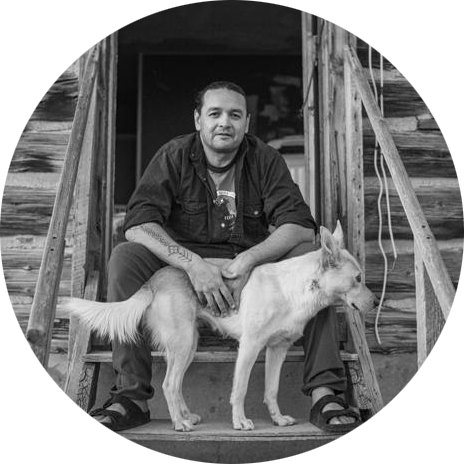

Jason Baldes
Executive Director, Board President & Eastern Shoshone Tribe Buffalo Manager